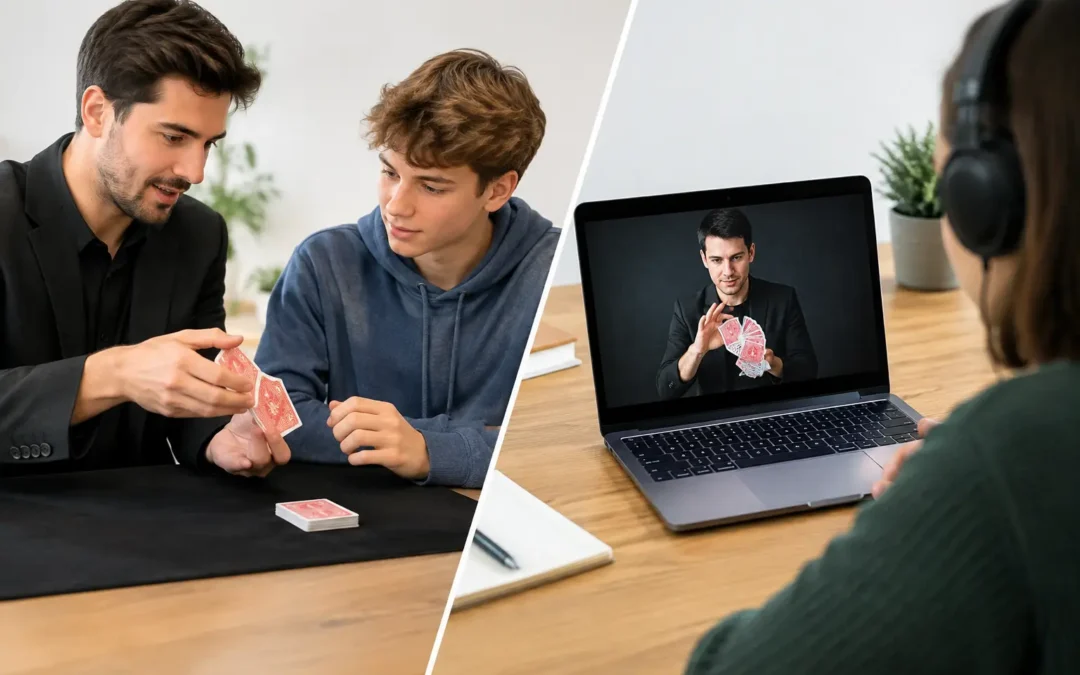
A child watches a magician make a coin vanish, then spends the rest of the evening trying to recreate it with a quarter from the kitchen drawer. That spark is exactly where many young magicians begin. But when it is time to learn, parents often face the same question: magic lessons versus online videos – which one actually helps a beginner become a confident performer?
Both can be fun. Both can teach real tricks. And both have limits. The better choice depends on whether your child simply wants a few clever secrets for family gatherings or wants the skills, confidence, and showmanship to make people truly feel amazed.
Magic Lessons Versus Online Videos: The Big Difference
The largest difference is not the number of tricks available. Online video platforms offer more tricks than anyone could learn in a lifetime. The difference is guidance.
A video can show a method, but it cannot watch your child perform. It cannot spot a hidden move that flashes, hear a rushed sentence, or explain why a trick that looked easy on screen is falling flat in the living room. Magic lessons put an experienced teacher in the room with the student, turning a secret move into an entertaining moment.
That matters because magic is not just about fooling someone. A successful trick has a beginning, a surprise, and a finish. It needs timing. It needs eye contact. It needs the confidence to keep going when a card lands in the wrong place or a spectator asks an unexpected question.
For a beginner, a good teacher makes those details feel exciting rather than intimidating. They can say, “Try that again, but slow down,” or “Let the audience look at the coin before it disappears.” Small corrections like these often create the biggest improvements.
What Online Magic Videos Do Well
Online videos earn their popularity for good reason. They are easy to access, usually inexpensive, and packed with inspiration. A curious child can watch a magician perform with cards, ropes, coins, rubber bands, or everyday objects, then immediately want to try something new.
For casual learners, that convenience can be perfect. If the goal is a quick trick for a school lunch table, a family holiday, or a birthday card, a clear video tutorial may be all they need. Videos also let students pause, rewind, and review a move as many times as they want.
They can be especially helpful after a student has learned the basics in person. A young magician who understands simple card handling, misdirection, and presentation can use videos as extra practice material or a source of fresh ideas. In that role, online content becomes a useful supplement.
Still, the same endless selection that makes videos exciting can make progress harder. Beginners often jump from one flashy effect to another without practicing any one trick long enough to perform it well. They may learn a secret, skip the presentation, and move on before the magic has a chance to become memorable.
There is also the quality question. A polished performer can make a difficult trick look effortless. A short tutorial may leave out the practice required, the setup involved, or the reason a move works. Some videos teach good habits. Others encourage rushing, copying, or revealing secrets without teaching the responsibility that comes with performing magic.
Why In-Person Lessons Build Performers
Magic is a live art. The moment that makes an audience laugh, gasp, or lean closer happens between a performer and the people watching. That is why live instruction has a special advantage.
In a class, students practice in front of real people. They learn how to introduce themselves, hold their props where everyone can see, and wait for a reaction instead of talking over it. They discover that a mistake does not have to ruin a performance. With the right attitude, it can become a funny moment and a chance to recover.
Feedback Makes Practice Count
A teacher can give feedback that is specific and encouraging. Maybe a student has mastered the secret move but keeps looking at the wrong hand. Maybe the trick is strong, but the story is too long. Maybe their voice is so quiet that grandparents at the back of the room cannot follow along.
Those details are difficult to recognize alone, especially for children. Personalized coaching helps students replace random repetition with purposeful practice. Instead of doing a trick 50 times the same way, they can spend 15 minutes improving the exact part that needs work.
Community Adds Motivation
Learning beside other young magicians creates a kind of energy a screen cannot provide. Students see different approaches, cheer for one another, and learn that every performer has moments that need work. It is easier to stay motivated when there is a class to attend, a teacher who remembers your progress, and friends who want to see what you have been practicing.
For many children, that shared environment is where confidence grows fastest. They may start by performing for a partner, then volunteer to show the group, then proudly present a trick at home. The trick matters, but the willingness to stand up and share it can matter even more.
The Cost Question: Cheap Access or Real Value?
Online videos often appear to be the budget-friendly option. Many are free, and even paid tutorials can cost less than a series of lessons. If a child loses interest after a few days, that low entry cost can feel sensible.
But value is not only about the first price. Consider what the student receives: a random tutorial, or a learning experience that includes structure, practice, feedback, and performance opportunities. A few well-taught effects that a child can perform confidently may be more valuable than 30 tricks they only half understand.
In-person instruction also tends to reduce frustration. When a move feels impossible, a teacher can adjust the grip, recommend an easier version, or explain the missing step. That can keep a child engaged instead of convinced that they are “bad at magic.”
The best option may depend on your child’s interest level. For a child who is simply curious, begin with a simple, age-appropriate trick and see whether the fascination sticks. For a child who constantly performs for relatives, talks about becoming a magician, or wants to shine at a party, lessons are often a worthwhile next step.
A Better Answer Than Choosing Only One
This does not have to be an all-or-nothing decision. The strongest path for many beginners is lessons first, videos second.
A teacher can establish the fundamentals: how to handle props naturally, respect the audience, protect a secret, and build a routine that has a real ending. Once those foundations are in place, carefully chosen videos can provide extra material to explore at home.
Parents can help by asking one useful question after a child watches a tutorial: “Who are you going to perform this for?” That question shifts the focus from collecting secrets to sharing an experience. Encourage them to practice the introduction, the surprise, and the ending, not just the hidden move.
It also helps to set a small goal. Rather than learning five new tricks before Saturday, choose one trick and prepare it for a specific audience. It could be a grandparent, a sibling, a classroom, or guests at a family gathering. A real audience gives practice a purpose.
When a Live Magic Class Is the Right Fit
Look for in-person magic lessons when your child wants more than a quick tutorial. It is an especially good fit for students who enjoy attention, need a confidence-building activity, love puzzles, or are eager to perform at birthdays and family events.
A welcoming class should make magic feel fun, not overly serious. Beginners need room to laugh, ask questions, and make mistakes without embarrassment. They should leave with practical skills and the excitement to show someone what they learned.
At Houston Magic Academy, students can learn from working magicians in an atmosphere built around the joy of live performance. The goal is not to turn every child into a professional overnight. It is to help them discover that preparation, personality, and a little mystery can make them the most interesting person in the room.
Online videos can start the spark. Great magic lessons can help that spark become a performance people remember. Give your young magician an audience, a little encouragement, and enough time to make one impossible moment feel completely real.