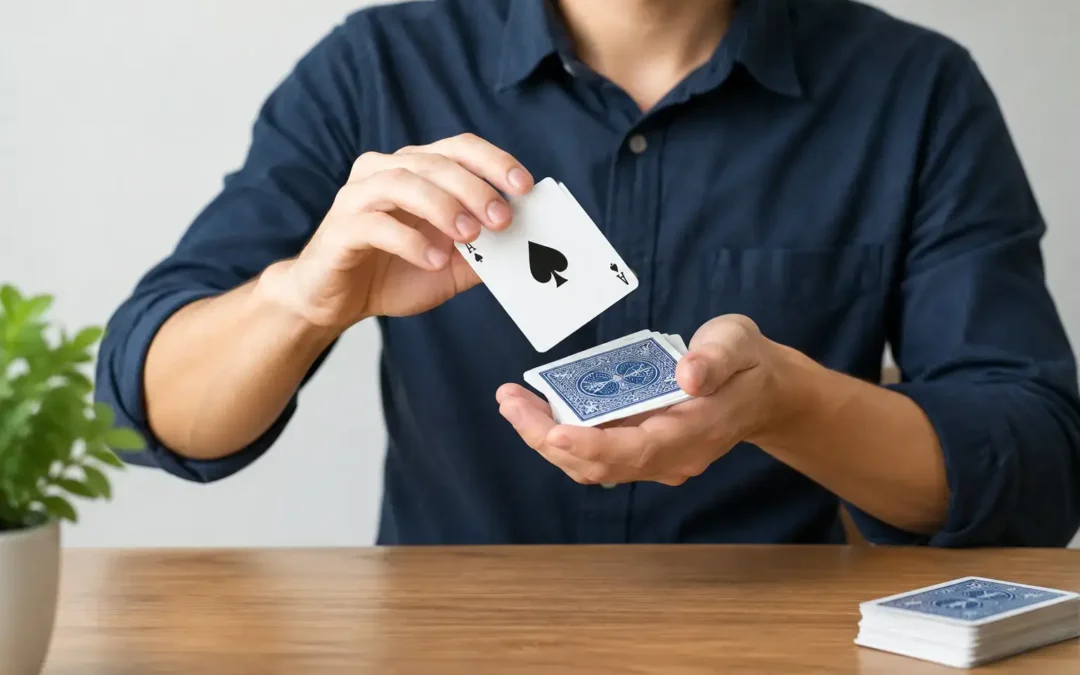
A deck of cards can turn a quiet kitchen table, birthday party, or family game night into a moment everyone talks about. The best card tricks for beginners do not require lightning-fast hands or a mysterious black box of props. They create a clear surprise, give you room to connect with your audience, and let the magic happen right in their hands.
The secret is choosing effects that look impossible while keeping the mechanics manageable. Start with one or two tricks, practice until you can smile and talk while doing them, then perform them for real people. That is where the fun begins.
What Makes a Great Beginner Card Trick?
A good first trick has a simple plot. Someone selects a card, makes a choice, or follows an instruction. You make an impossible prediction, find the card, or cause it to change. The audience should always know what they are watching for.
Avoid routines that ask people to remember long strings of cards or complicated rules. Those can be clever, but clever is not always entertaining. For families and casual audiences, the strongest tricks are visual, easy to follow, and quick enough that the surprise arrives before attention wanders.
You will also get better results with a normal deck of cards. Specialty decks and gimmicks can be exciting later, but an ordinary deck feels fair. When a spectator sees their own card vanish, appear, or turn over in a standard pack, the reaction is bigger.
10 Best Card Tricks for Beginners
1. The Key Card Find
This is the classic first card trick for a reason. A spectator picks a card, returns it to the deck, and you secretly use a known card next to theirs as your guide. After a little suspense, you find their selection.
The method is simple, but the performance can feel personal. Ask the spectator to remember their card, spread the deck slowly, and let them see you are looking for a clue. Do not rush straight to the answer. A pause makes the reveal feel more magical.
2. The 21-Card Trick
The 21-card trick is a self-working favorite that teaches an important lesson: a trick can be mathematically certain and still feel like pure mystery. Deal 21 cards into three columns, ask which column holds the chosen card, gather the columns in the correct order three times, and the card lands in a known position.
This is a terrific trick for kids and new magicians because your hands do not need to be fast. The trade-off is that it takes a little longer than other effects, so keep the presentation playful. Tell your audience you are narrowing down their card with “card detective work.”
3. The Do as I Do Match
Two people each choose a card from separate halves of the deck. You both make the same choices, and somehow you end up with matching cards. The plot is easy for everyone to understand, which makes the ending especially strong.
This trick works beautifully for couples, siblings, and parent-child pairs because it feels like a shared coincidence. The real secret is not just the method. Give the two participants a reason to believe their choices are completely independent.
4. The Upside-Down Card
Have a spectator choose a card and lose it in the deck. When you spread the cards face down, one card is mysteriously face up. It is their card.
This is one of the best card tricks for beginners who want a visual finish. A reversed card stands out instantly, even across a crowded table. Practice handling the deck naturally before you perform it. If you appear overly careful at the key moment, people will know exactly where to look.
5. The Prediction Envelope
Before anyone selects a card, place a written prediction in an envelope or fold it on the table. After the card is chosen, your prediction matches. The suspense begins before the trick even starts because your audience can see that you committed to an answer.
There are several beginner-friendly ways to accomplish this, including force cards and simple outs. Start with a reliable version rather than trying to make every choice completely free. A clean, confident prediction is far more entertaining than a complicated method that occasionally goes wrong.
6. The Four Ace Assembly
The four aces are placed into separate piles. With a few magical gestures, they gather together in one pile while the others are left empty. It has the feel of a larger stage illusion, but it can be learned in small pieces.
This routine takes more practice than a key card trick, yet it is worth the effort. It teaches you how to tell a story with cards. Instead of saying, “Now the aces move,” give them a role: four adventurous aces trying to meet up after being separated.
7. The Rising Card
A selected card slowly rises from the middle of the deck as if it has a mind of its own. Even a basic version gets a big reaction because the magic happens visibly rather than during a shuffle or cut.
This effect is ideal when you want a little theater. Keep your movements still, look at the deck with the audience, and let the card rise slowly. The slower it looks, the less anyone suspects that your hands are doing anything at all.
8. The Color Change
A card is shown clearly, waved or rubbed, and changes into a different card. Color changes can be short, punchy, and unforgettable, especially when the original card is a signed selection.
This category depends more on practice than self-working tricks do. Work in front of a mirror or record yourself on your phone. The goal is not speed. It is making every action look relaxed, as though you are only squaring the deck or turning over a card.
9. The Card Under the Box
A selected card seems lost in the deck, only to appear underneath the card box that has been sitting in plain sight. The impossible location gives the ending a satisfying jolt.
Use this as a finale after a few simpler tricks. By then, your audience will be focused on the deck, not the box. That is a useful magic principle: people tend to watch what the story tells them matters.
10. The Impossible Card Location
For this type of routine, a spectator names a number, spells a word, or makes a series of fair-looking decisions. Their card appears at the exact location predicted by the process. The method may be self-working, but the experience feels impossible because the spectator seems to be in control.
This is a great choice for a thoughtful child or adult who enjoys puzzles. Just make sure the instructions are clear. If the procedure becomes confusing, the final revelation loses its punch.
Practice Like a Performer, Not a Puzzle Solver
Knowing how a trick works is only the start. The moment you perform, your job is to make the audience feel included, not tested. Speak clearly, keep the cards visible, and give one person a simple job such as holding the deck, naming a number, or guarding your prediction.
Practice the handling until your hands can do it without your full attention. Then practice the words. A trick often becomes memorable because of a funny line, a dramatic pause, or the look on a kid’s face when they realize their card is somewhere impossible.
It also helps to rehearse your recovery. Cards get dropped. Someone forgets their card. A younger spectator may excitedly grab the deck at the wrong moment. Smile, reset, and treat it as part of the show. Real confidence is not never making a mistake. It is keeping the room comfortable when something unexpected happens.
A Few Rules That Make Card Magic Stronger
Never repeat the same trick immediately for the same group. People may not know the secret, but a second viewing gives them time to hunt for it. Instead, follow a card-finding trick with a prediction or a visual change.
Do not announce that you are about to do something “hard.” The audience wants to enjoy the impossible, not worry about whether you will succeed. And never explain a trick right after you perform it. Let the mystery have its moment.
For young magicians, choose tricks that fit their hand size and attention span. A simple revelation performed with excitement will beat an advanced sleight performed nervously every time.
Bring the Wonder to the Table
Card magic is not about fooling people in a cold, gotcha way. It is about creating a tiny shared surprise. One person remembers a card, everyone leans closer, and suddenly the ordinary deck on the table feels extraordinary.
If your family loves that feeling, seeing a live magician can make the next spark of inspiration even bigger. Magic Show Theater brings laughter, illusions, and close-up wonder to audiences who want an experience they can enjoy together. Start with a deck, pick one trick, and give someone a reason to say, “Wait… how did you do that?”